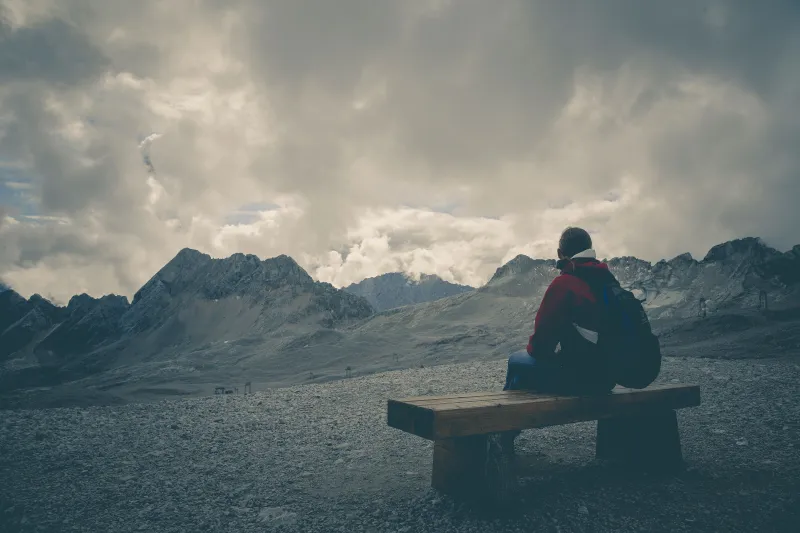
Still in the Game: How Adventurers Are Rewriting the Rules When Their Bodies Change the Playbook
Photo: Santa Monica Mountains National Recreation Area, Public domain, via Wikimedia Commons
Mike Torrance spent fifteen years running technical mountain trails in Colorado. He finished his first 100-miler at 38, his second at 41, and was deep into training for a third when his left knee stopped cooperating entirely. Two surgeries later, the trails he'd run in his sleep were suddenly a different kind of challenge — one measured not in miles per hour but in whether the descent would leave him unable to walk the next morning.
He's not alone. Not even close.
Across the US, a generation of adventurers is hitting a wall that the outdoor industry barely acknowledges and adventure media almost never shows: the moment when your body and your ambitions stop speaking the same language. It might arrive as a sudden injury. It might be the slow accumulation of years on hard terrain. It might just be the unremarkable arithmetic of age. However it comes, it forces a question that nobody really prepares you for: who are you as an adventurer when you can no longer do the thing that defined you?
The Youth Bias Nobody Admits To
Flip through the pages of any major outdoor magazine, scroll through the most-followed adventure accounts on Instagram, watch the highlight reels that dominate outdoor YouTube. Count how many of the featured athletes are over fifty. Over forty-five. Over forty, even.
The numbers tell a story the industry doesn't like to say out loud: adventure culture, as it's packaged and sold, is aggressively young. The bodies doing the most dramatic things — the free solos, the FKT attempts, the first descents — tend to be in their twenties and thirties. And while those accomplishments are genuinely remarkable, the singular focus on peak physical performance creates a cultural narrative that leaves a lot of people feeling like their best adventure years are behind them the moment their body starts to change.
That narrative is both inaccurate and genuinely harmful. And a growing number of adventurers are actively dismantling it.
Adaptation Isn't Defeat
For many people, the shift begins with a forced pause — an injury that sidelines them long enough to step back and look at their relationship with their chosen pursuit. That distance, painful as it is, often creates space for something unexpected: the realization that there's more than one way to be in the game.
Take kayaking. For paddlers who've spent years chasing Class V whitewater, a shoulder injury or the cumulative wear of decades on the water can make high-consequence paddling genuinely unsafe. Some step away entirely. Others discover sea kayaking — a discipline that rewards endurance, navigation skill, and environmental reading over raw physical power. The adrenaline profile is different. The rewards are too, and for many paddlers, the trade turns out to be richer than they expected.
The same pattern shows up across disciplines. Climbers who can no longer project hard sport routes find themselves drawn to traditional climbing, where route-reading and gear placement matter as much as finger strength. Trail runners who can't sustain the impact of racing pivot to fastpacking — covering serious terrain with a light kit, on their own schedule, without the clock. Mountain bikers who've had one too many crashes on aggressive descents start exploring bikepacking routes that prioritize distance and scenery over technical difficulty.
None of these are lesser versions of the original pursuit. They're different pursuits, with their own demands and their own rewards. The people who figure that out tend to have longer, more sustainable adventure lives than those who keep trying to do exactly what they did at thirty.
The Mentorship Pivot
There's another path that doesn't get nearly enough attention: the turn toward teaching.
Adventurers who've spent decades in the field carry a kind of knowledge that simply can't be replicated by someone who's been at it for two or three years. They've seen conditions go bad and recovered. They've made the wrong call and learned from it. They've developed the situational awareness that only comes from genuine time in the field — the ability to read a sky, a river, a snowpack, or a trail in ways that no YouTube tutorial can fully communicate.
When that knowledge gets passed to newer adventurers, something valuable happens. The community gets safer and more capable. And the experienced adventurer finds a new source of meaning that doesn't depend on their body performing at its former level.
Guiding, mentoring, volunteering with youth outdoor programs, leading club trips for newer members — these roles keep experienced adventurers connected to the thing they love while shifting the currency from personal performance to collective contribution. For a lot of people, that shift turns out to be genuinely fulfilling in ways that chasing personal records never quite was.
Redefining the Metrics
Part of what makes physical change so difficult for adventurers is that the culture has handed them a very specific set of metrics for measuring success. Summits reached. Miles logged. Difficulty ratings conquered. Finish lines crossed. When your body stops cooperating with those metrics, it can feel like you're failing — even when you're still out there, still moving, still showing up.
The adventurers who navigate this transition most successfully tend to be the ones who quietly rebuild their metrics from scratch.
Instead of asking 'how fast did I go,' they ask 'how much did I notice.' Instead of measuring vertical gain, they measure depth of experience — the quality of the morning light, the wildlife they spotted, the conversation they had at camp with someone twenty years younger who needed to hear what they know. Instead of chasing the hardest route, they start chasing the most interesting one.
This isn't settling. It's a different kind of expertise — the expertise of knowing how to be fully present in a place rather than just moving through it as quickly as possible.
What the Community Gains When It Stops Looking Away
The outdoor community in the US is getting older. The demographics are shifting, and the wave of people who came to adventure in their twenties and thirties are now in their forties, fifties, and sixties, with no intention of stopping. They're a massive, largely underserved segment of the adventure audience — and more importantly, they're a resource that the community consistently fails to fully use.
When adventure culture makes room for older and injured adventurers — not as a charity gesture but as a genuine acknowledgment of their value — everyone benefits. The community gets wiser. The culture gets more honest about what long-term adventure actually looks like. And the newer adventurers, watching someone in their sixties navigate a trail with skill and joy and no apparent need to prove anything, get a picture of what's possible that no sponsored athlete highlight reel can provide.
Your body will change the terms eventually. The adventure doesn't have to end. It just has to evolve — and that evolution, if you let it, might take you somewhere more interesting than where you started.